

One of the things I have been considering is futzing about with music again. Like creative writing in my previous post, that also has a well that dries up, especially as I don’t usually have collaborators to bounce ideas off anymore. And my tooling around is more for the purposes of learning new recording, engineering and playing techniques than it is for performance. Much like publishing my writing, I am more interested in the joy of creation than I am in the idea fame or profit.
[Trigger Warning: Musician-speak ahead and I don’t explain the terms I am using. Enter at your own risk.]
I have been looking for a new synthesizer for some time now: everything from a traditional keyboard-hardware synth to a keyboard-less rack synth to a “soft synths”. The pricing goes from high to low in the above types and, while I had my eye on a couple of the higher end items (yet still well below the “pro” synths that cost $1000-$5000), I still had a hard time justifying the cost for a hardware synth in the $300-$1000 range when the software-emulated versions run anywhere from $35-$150 with Black Friday discounts. Or less, although the sub-$50 variants (before sale pricing) tend to lack quality. That’s not to say that there aren’t some overpriced low-quality items out there, but it tends to become more rare over that $50 threshold.
Yesterday, I decided to take a few virtual software-emulated synths out on test drives to see if those with 50%-off Black Friday prices grabbed me.
One of the hardware synths that has intrigued me, but is absolutely outside my price range has been the Oberheim series of synthesizers. Their old hardware models were very popular in the 70s through the 90s, and are responsible for the sounds of Vangelis, Prince, Van Halen, New Order, Nine Inch Nails, Depeche Mode… the list is quite extensive.
I tried out a couple of iterations based on the classic analogue synths and actually fell pretty hard for the GForce Oberheim OB-1. Unlike the monophonic original, the emulated version allows for polyphonic sound (although you can retain the monophonic via programming if you want to keep it more “authentic”). Tom Oberheim, the original engineer of the earlier synths endorses this emulation and his company provided tweaks to the software to flesh out what GForce missed. What I liked about the synth is that it has that edgier, fatter sound that seems to be missing from a lot of software synths these days. It also seems to be a great interface for exploring crafting your own patches, keeping it simple on the surface but adding a lot of hidden potential for someone who wants to dig in. It also has a pretty good arpeggiator and sequencer, another tool that I’ve been meaning to start doing more programming with in my music.
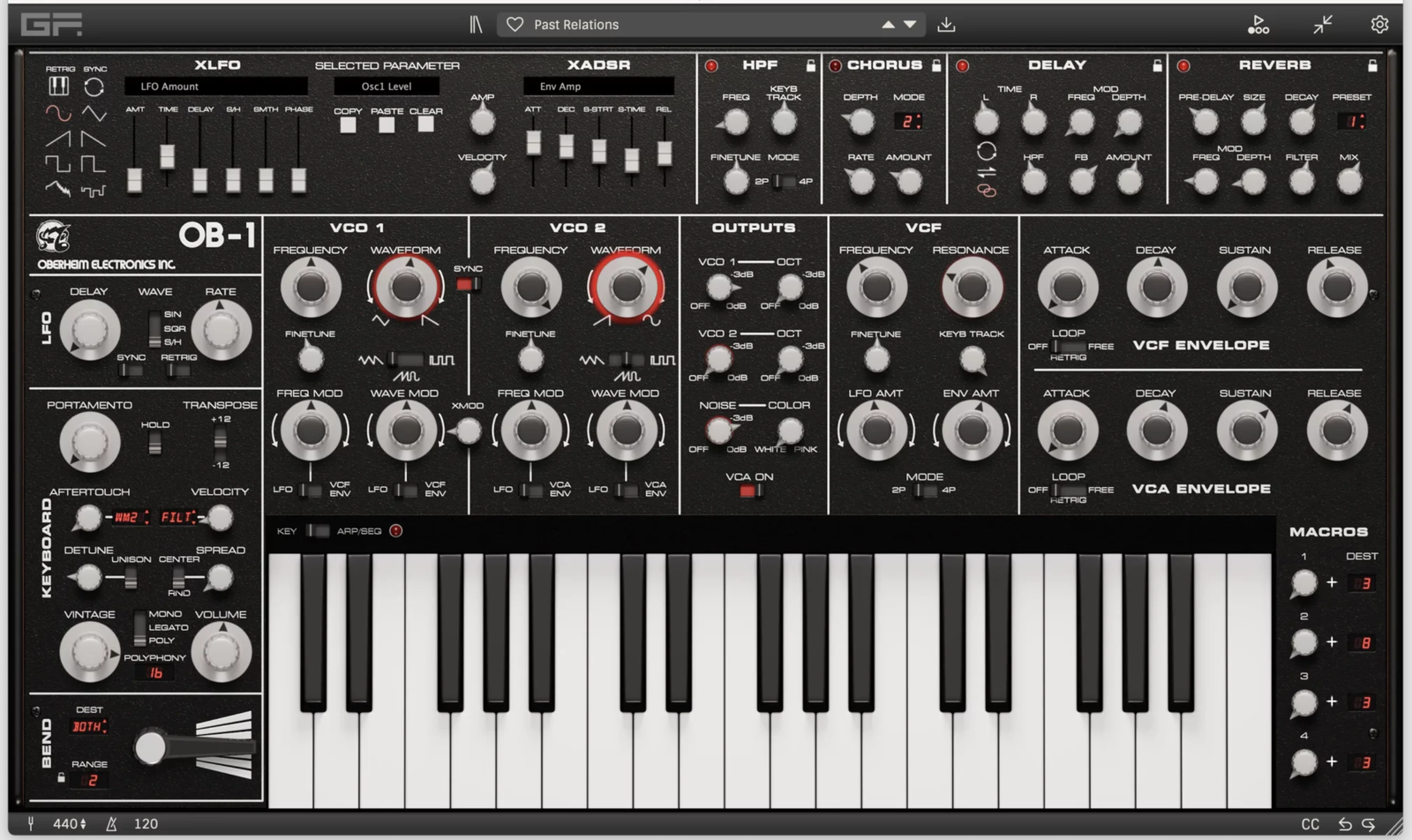
Using the demo in my workbench, I had three instances of it going with no lag or distortion, along with a drum track (different virtual instrument). And load times for patches were instantaneous (some virtual synths can take several seconds to load, especially those employing sampled wavetables). Within an hour, I had a decent backbone of a song to build from (00s era experimental alternative sound) and I had a few other ideas pending (more trad 80s industrial along the lines of Skinny Puppy, KMFDM, Thrill Kill Kult, NIN, etc., than modern bands). And that’s before I started playing around with crafting my own patches.
And I have another 6 days to explore before the demo expires, which is a fantastic trial period.
That’s the exact opposite experience I had with a few others out there. One only lets you demo the virtual synth for 20 minutes! It required five times the memory, was laggy (with only a single instance running!) and seemed more interested in the visual presentation (lots of CPU-heavy shiny stuff) than in the actual sound, which sounded wooden instead of lush. And, they wanted almost twice the price (before sale pricing) of the OB-1 emulation! It was the same company as the one that produced a hardware synth for about $600 I had considered and, let me tell you, I was so turned off by the software one I tried that it is highly unlikely that I’ll pick up their physical synth if/when I think in those terms.
I also think I’ll be upgrading my DAW to the annual subscription variant. I had considered paying for the upgrade from Reason 12 to Reason 13, but the annual subscription is about $25 more and, doing so, opens up a ton of other virtual instruments and tools that are normally a la carte. I end up paying only slightly less for my infrequent upgrades (I’m cheap) over time, so it seems smart to at least try out the sub for those other tools. If I don’t utilize any of it after a year, well, I’ll just downgrade to the standard variant of the DAW.
We’ll see if any of it is posted here. Probably, as usual, only snippets, but who knows? Maybe I’ll post a full song in the future!
5 responses to “Blue Monday”
As a beginner, I went with a (universally recognized) midi that has basic synth and other controls on the board. It’s programable, can record loops and sessions, has synth pads and a free Ableton subscription as a DAW. I don’t like Ableton, only because I’ve learned more with ProTools (even though I’m still struggling). The midi board is recognized by ProTools, and every DAW I’ve tried, thus far.
Hope Black Friday is kind to you and you find what you’re looking for.
I have a Roland Juno, but have found that I prefer to use a “dry” midi keyboard to drive things when I am composing; alternately, I use a real guitar, or real bass when the sound suit live instruments better. Occasionally I’ll mic an instrument. I avoid singing [sic] when I can 🤣
I didn’t care so much for Ableton either when I trialed it. I know some people really like it, but it wasn’t intuitive for me, coming away from old-school Cakewalk (very old school) and Sony Acid (which I used as a DAW even though it was designed more for loop management). I think ProTools was out of my price range when I was demoing DAWs to replace Acid, and Reaper (a free DAW for those folks looking for a DAW on the cheap) was still not quite ready for prime time. Reason was familiar and intuitive and I haven’t seen any good reason to change.
Intuitive is important, so if ProTools is intuitive, then it’s perfect for you!😉
I frequently use Audacity for final conversion to MP3, as Reason does not have an MP3 license included. That’s another great free tool for simple multitrack recording, although not really a DAW. I use it for spoken word as well.
Yep,, right over my head. But hope you enjoy it to the max. 🙂
Sorry for the trauma 😉
😂😂😂