
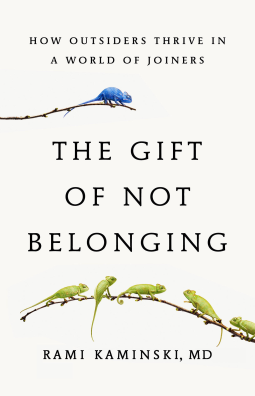
When I saw mention of the book on Lodestarwytch’s site a while back, I’ll have to admit that the title/subtitle combination caught my attention right off the bat.
I, myself, have realized for quite some time now (maybe since forever) that I don’t really fit in and that I am a bit of an outsider for as long as I can remember. I’ve always been a bit baffled by how people “fit in” to a group and I have often wondered if there was something a little wrong with my wiring because of the fact.
Dr. Kaminski, a New York psychiatrist, has come up with an alternative to the popular extrovert/introvert dichotomy, a term he has coined as being an otrovert: which involves “a persistent sense of being an outsider in group settings, even when the person is socially included, and a preference for selective, one-to-one connections over group affiliation.”
While reading through his description of what makes up the otrovert, I found myself nodding and thinking.: “Yeah, this describes me, pretty much to a T.” There is even a handy-dandy quiz included that helps the reader determine the likelihood of being someone who is neither introverted nor extroverted, but something else. And, as you might imagine, I passed the quiz with flying colors (pivot point is a score of 188 and I scored around 360 on the scale).
I found the whole thing very compelling, but then the scientist side of my brain (I am both a creative person and someone who does STEM-related things for my paying job) kicked in and started poking into the book deeper.
The book itself is laid out very much like the 80s-90s era self-help books (they may have continued in that fashion, but I don’t typically read that kind of book these days), but missing the help portion unless the reassurances that you are not a freak is the help provided. None of this is criticism, just observation.
However, I did have some criticisms.
The biggest of which was how the quiz is presented, which is very leading in both questions and responses. I recommend taking it before reading the book, rather than afterwards, because the questions are almost directly from the text, making it more like a test of what you read than a serious diagnostic tool. Not only are the questions near-direct quotes from the book and placed at the end (intended to be discovered after reading, as it is never called out in the text and only a line item in the TOC), but the scoring system is set up where the highest scoring item is always the one that is more indicative of being a otrovert.
Another significant criticism I have is that the evaluation of the personality type seems very much based on personal anecdotal evidence from the author’s time as a psychiatrist. He does not provide scientific-based evidence for his pet theory, nor reference any studies that support his approach. He does reference quotes from historic personages and authors that he has classified as otroverts — which, lacking any clinical knowledge of the person he is quoting, he is all too happy to put them into the otrovert box when the quote sounds very otrovert-y. I would have liked to at least seen some kind of study in progress, or some rationale aside from a set of criteria he has established to define what an otrovert is.
And that criteria is pretty broad, which is why your average person is likely to score relatively high on the quiz (maybe not as high as myself, but I’m a weirdo), especially if they take the quiz after reading the book. I guess the kitchen sink feel to the criteria Dr. Kaminski proposes feels more like he is trying to get on a talk-show than actually out of an interest in helping people find their way a little better than they might with his book.
Was it a bad book? Certainly not. It has some interesting concepts and ideas that I think warrant further investigation. But as a manual for truly understanding a nuevo personality type category, I found it missing some essential ingredients that could have made it a knock-out text. I feel that it could have done with a heavy dose of query before it was published, but that is more a editor/publisher problem than it is an author problem. They should have presented the text with stronger criticism before it was released, and that is not just with the criticisms above, but with more minor things like the use of FOMO (fear of missing out) without actually defining it anywhere (just the acronym), and the inclusion of one line of political statement that was jarring near the end (the political comment has no place in the text and will not age well, even if I happen to agree with it). Or footnoting literary quotes when you already referenced them in-line. It was ticky-tacky things like that which got past the editors and publishes that made the otherwise easy read of a book feel sloppy.
While I liked some of the ideas, I felt the lack of evidence-based details, broad generalizations, and some of the unpolished feel made it a book less than I had hoped it would be. Recommended reading for the outsiders in this world, as it may help you reframe your understanding of yourself in a more positive light, but take most of it as “good ideas” rather than established guidance. If you have no interest in better understand personality types, I cannot recommend reading it. I feel like these ideas might have been taken out of the oven too early and need to bake a little longer.
In fact, if you are not otrovert-leaning, you might actually be offended by some of what is within the book (several reviews have valid criticisms about how anyone who is not a otrovert by the book’s definition might be insulted by some of the author’s methods of defining what this personality type is by way of excluding them in the phrasing; i.e., hivemind, followers, joiners… basically “sheeple”, but not quite so obtuse as all that).
11 responses to “reads — The Gift of Not Belonging, Rami Kaminski”
This book is on my list. I recently took the “personality test” and righteously qualified as being an outsider/otrovert. I have a few more books ahead of it, then I’ll dive in. It’s good to see your POV.
As I said, he’s got some good ideas, but I’d like to see more research and evidence before jumping in too deep with accepting his theories. Let me know what you think when you get to it!
What a pity the book didn’t quite come up to expectations on so many counts, Michael, because I can identify with the “‘persistent sense of being an outsider in group settings, even when the person is socially included, and a preference for selective, one-to-one connections over group affiliation” side of things. I might give it a look though, so thanks for sharing. 🙂
It’s not a bad book, it just feels more like something you or I might write with a pet theory instead of by a doctor who should know how to provide supporting evidence other than anecdotal stories. And they should know how to write those kinds of tests to eliminate leading questions and biased responses.
I encourage folks to read it, just with the proper framing in mind.
I’ve put it on my wish list, and will keep your warnings in mind. Thanks! 😊
I’ll be back when I finish the book – since I’ve got an old ankle injury acting up today might be a good day for reading 😅
It might be! I know how that goes.
Were you are least having fun when you injured it?
Honestly it was one of those stupid teenage decisions 🙄 I did enjoy the flying through the air bit but the landing needed work 😅 🙃
🤣 Hopefully your ankle feels better soon.
In one way I agree that his generalisation is probably as off-putting to someone with a ‘hive mind’ but honestly how long has introverted/quiet been used as an insult by extroverts…? Playing devil’s advocate here but thought I’d throw that one in the mix 😅
You’ve got a point there. But it’s hard to be inclusive when you sound tone deaf to the non-target audience. It makes empathy difficult for those that it doesn’t apply.
Thanks 😊